

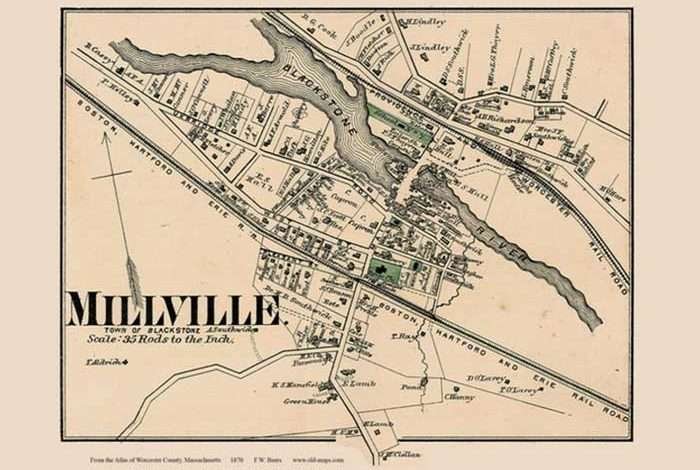
A Town of Its Own: Millville’s Separation from Blackstone.
On May 31, 1916, the village of Millville rang with bells, echoed with cheers, and filled its streets with proud townspeople marching in celebration. After years of petitioning, debating, and dreaming of autonomy, Millville finally stood on its own—officially becoming Massachusetts’ second-youngest town. The moment was more than legal paperwork. It was a powerful statement of identity, pride, and community spirit that lives on to this day.
From Mendon to Millville
To understand how we got here, we have to travel back to the 1700s. Millville’s story begins as part of Mendon, a much larger colonial town. By 1766, the population near the Blackstone River had grown large enough to form the South Parish of Mendon.
In 1845, the South Parish became the new town of Blackstone, and Millville went along with it. For decades, both villages thrived—driven by the power of their riverside mills. Blackstone focused heavily on textile manufacturing, while Millville’s prosperity grew from industries like rubber, most notably the Bannigan mill.
Despite their shared roots, Millville began to develop its own personality—and its own needs.
“Blackstone Gets the Sidewalks, Millville Gets the Saloons”
By the early 1900s, residents in Millville started to feel they weren’t getting their fair share. Their concerns ranged from lack of state funding to unequal representation in town decisions. A popular saying at the time summed it up: “Blackstone gets the sidewalks, and Millville gets the saloons.”
Tensions grew as Millville’s schools, churches, and businesses built strong community ties separate from Blackstone’s. In January 1916, the village introduced a bill to the Massachusetts Legislature asking to become its own town.
A Battle of Wills—and a Victory for the Village
The Legislature unanimously approved the bill, but it hit a bump when Governor McCall vetoed it. Millville’s supporters didn’t give up. The House and Senate rallied again and overrode the veto in May 1916.
Not everyone agreed with the split—there were voices of support and opposition on both sides—but the bill passed, and Millville became an independent town on May 1, 1916.
A Day to Remember: May 31, 1916
Millville didn’t let its new status go unnoticed. Just a few weeks later, on May 31, the town threw a celebration that, by some accounts, drew more than 10,000 people.
There was a grand parade that wound down Main Street, across the Blackstone River, and up Central Street. Three hundred children marched proudly. Girls and women from the local mills rode floats they decorated themselves. Teachers and students, industry workers, and town leaders all joined in.
All the mills closed for the day, but the mill bells rang, factory whistles blew, and the town’s church and school bells sang out in unity.
It was a moment of joy, resilience, and hometown pride.
Millville Today
More than a century after gaining its independence, Millville remains a close-knit, residential town defined by quiet roads, historic charm, and a strong sense of community. Ask the families who’ve called Millville home for generations, and they’ll tell you the same thing:
Millville’s greatest strength has always been its identity — the pride of being a small town with its own voice, values, and spirit of independence.
Share Your Millville Memories
At Small Town Post, we believe local history should be shared, celebrated, and passed on. If you have photos, family stories, or memories related to Millville’s separation from Blackstone—or anything else from town history—comment down below!
Historical information in this article comes from the Blackstone Heritage Corridor and the Blackstone Historical Commission’s printed book Blackstone, Massachusetts: A Town History Through 1995.



As part of the petition filed, what name was to be given to the new town ? Hint – it was not ‘Millville’
OOOH! That is very interesting! Please do share!!
Side note: Love seeing this tidbit of history, thank you Small Town Post!